Monday, March 21, 2011

Then, Now, and the Future

When I watch The Social Network I can't help but laugh when I see where Facebook started and what it looked like then and now. There have been so many advancements and changes in the design of the site that it's kind of funny to think about. When the site was launched in 2004 it was a lot different than the facebook we are accustomed to today. The layout was completely different and there weren't nearly as many applications.

Now, facebook users can upload and be tagged in thousands of pictures (yes I know people with that many photos). They can write every single detail of their life if they so choose as well. Some of the recent additions to facebook that were not present when it was first released are "facebook chat" and games such as Farmville that many people love. There are so many ways that each and every user is connected that wasn't even dreamed of when facebook first started.

As I write this I wonder if one day, as more and more people in so many countries of all ages are using facebook, we will be able to tell how accurate the idea of "six degrees of separation" actually is. I know very little about writing code, but I am sure a skilled programmer could come up with some way to determine how close we are to everyone in the world. It would be so simple with facebook when on everyone's page we see who our "mutual friends" are. It seems that through a few steps we could see how close we are to someone on the other side of the world. It will be interesting to see how we could possibly become more connected with everyone in the future. I'm sure Mark Zuckerberg and the developers at Facebook will think of something.

Tuesday, March 15, 2011

Project 3 Proposal


I am choosing to do my research paper on the effects of the Internet on the Music Industry. I can recall my experiences with recorded music from cassettes to CDs to iTunes to LimeWire and other illegal methods to download music. I am curious as to the overall affect the Internet has had and where the music industry is going to continue to make money.

I hope to answer questions such as “When did the Internet first start affecting the way music was obtained?” and “Was it a disruptive or progressive technology?” or even “Is the film/television industry next?” I am also curious as to the role of programs I have used before such as Napster, LimeWire, and even Steve Jobs’ iTunes. However, it may be difficult to research such a broad topic and determine the effects of one individual technology on an entire industry. I may have to focus solely on the distribution of music to consumers and possibly only a few companies such as Apple, YouTube, or possibly another.

It is clear that the Internet has helped advance the circulation of music and made consumers happier, but it is unclear whether or not the record labels, like Universal Music Group and Sony Music Entertainment, have been as welcoming of such freedom to share music. I look forward to being able to understand more of how these record labels are making profits when consumers, myself included, are downloading and sharing their media without paying them a single penny.


Alderman, John. Sonic Boom: Napster, MP3, and the New Pioneers of Music. New York: Basic, 2001. Print.
Alderman tells the story of the online music revolution that first started in the 1990s. He describes the geeks who pioneered the technologies of mp3 and peer-to-peer (P2P) sharing and the record labels who have fought against it. This will help with the history aspect of the Internet’s effect on the music industry.

Cassidy, Liam. "ITunes: Rebranding History: Apple News, Tips and Reviews «." GigaOM – Technology News, Analysis and Trends. 15 Mar. 2009. Web. 14 Mar. 2011. <http://gigaom.com/apple/itunes-rebranding-history/>.
This article describes the affect iTunes has had on the downloading of music from the consumer’s perspective. For my paper this will help with where the music industry currently is and its potential future.

Fink, Michael. Inside the Music Industry: Creativity, Process, and Business. New York: Schirmer, 1996. Print.
Fink examines every aspect of the music industry, exploring the ways the business has changed, from electronic media and digital recording technology, to changes in copyright law. This allows me to see how the Internet has affected the music industry from the perspective of the major record labels.

"The Influence of Internet on the Music Industry." Tabblo. Web. 14 Mar. 2011. <http://www.tabblo.com/studio/stories/view/250056/>.
This is the blog of a consumer and he recounts his personal experiences with music before the Internet and now after it. This blog will allow me to determine how the general public is responding to the Internet’s ease of access to music.

Tyson, Jeff. "HowStuffWorks "How the Old Napster Worked"" Howstuffworks "Computer" Discovery. Web. 14 Mar. 2011. <http://computer.howstuffworks.com/napster.htm>.
This article describes what Napster did for the entire music industry. Through my research so far, I have seen that Napster was the program that started the online music revolution. This article will allow me to better grasp what occurred and what aspects of Napster are still being used today.

The Way the Music Died. Dir. Michael Kirk. Prod. Michael Kirk and Jim Gilmore. PBS Home Video, 2004. DVD.
This Frontline documentary describes the path of the recording industry from post-Woodstock to the Internet dilemmas of today. This film will also help with my understanding of the history of the music industry and what happened when the Internet took over control of distributing music.

Humans as Computers as Humans

While reading "Mind Vs. Machine" by Brian Christian, there was one section of the article that truly shocked me. It made me think in a way that I never have before. On the second page, section "The Sentence," Christian states that "it's important to realize that computers used to be human." He is completely right. Every function that a computer does was something that someone had to do by hand with a pencil and paper or calculator. As humans we accomplished some amazing things without computers. I never realized that the first accurate prediction for the return of Halley's Comet and the Manhatten Project were done without the use of computers. They were accomplished solely by human beings with their vast mind power.

It really got me thinking that before computers were invented, we were computers. We did everything that they do and we still can. Computers are simply faster and a lot more accurate, but there is no real difference between what we can do. It also reminded me of my senior year of high school when I was taking calculus. My dad would occasionally ask me what it was I was doing in class. I'd tell him and he would reminisce of how he did the same thing, but instead of having a calculator handy, he had to do everything by hand or consult tables. We learned the same exact thing, but the only difference was that I was able to do my calculations a lot faster. One of the main advances that computers have been able to provide for us has been speed. Computers make calculations and perform tasks instantaneously.

I love being able to use a computer, but when I think about it we could survive without them. We would most likely still be where we are today or possibly slightly behind, but we would not be at a huge disadvantage. My parents and grandparents grew up without the use of computers and they were able to do everything that I can. It is interesting to see how Christian described computers as being human instead of humans as being computers. Humans still more advanced and smarter than computers, but for how much longer?

Monday, February 28, 2011

When Robots Ruled the World

I am a big movie guy and while reading "The Machine Stops" I can't help but think of one movie; WALL·E. The article and the film have so much in common, yet they were written almost 90 years apart. Both describe a world where humans have drifted away from the world we live in now and are blind to the hand controlling their every move. Both have a computer or "the Machine;" technologies that have a mind of their own. I can see a world very similar to the ones described in both "The Machine Stops" and WALL·E.

I am sure many people have heard the expression (most likely from their mother as a child) you shouldn't believe everything you hear. More and more today it seems that we believe every tiny bit of gossip we hear on the news, from friends, and now on the Internet. I fear that one day when individual technologies, even artificial intelligence, are providing us with the only outlet of information we will fall victim to their bias. We become puppets of this technological dictatorship and are no longer free individuals. Our entire lives are based upon the "Book of the Machine" and any rebellion is immediately put to rest.

Naturally we love technological advancement and new technology, but at what point does this technology we create begin to think on its own and control us. It is ironic that society's controller is called "the Machine." The people put their entire hope, trust, and lives into an inorganic android. I don't know about you but I prefer real humans with real emotions and real brains telling me what to do. We are definitely far away from Forster's imagined future, but with the emergence of IBM's Watson, I wouldn't say its that far away.

Wednesday, February 23, 2011

Welcome to Cyberspace, the Birthplace of the New You: Revised


As I begin to write this paper examining the future of the Internet and its effect on our lives, I reach an impasse. I am unable to connect to the Internet. I am confident that I can write the paper without the use of the World Wide Web, but the realization that it may not be a means for obtaining information brings forth a feeling of frustration and apprehension. I have become accustomed to having access to the Internet and the technology that ties everyone and everything together. How much more dependent on the Internet will I and society as a whole become in the next five years and into the future? Tim Wu and William Gibson describe how they perceive our future and the Internet in The Master Switch and Neuromancer, respectively. Their imagined futures are rather far-fetched, but they are worlds that are not impossible.

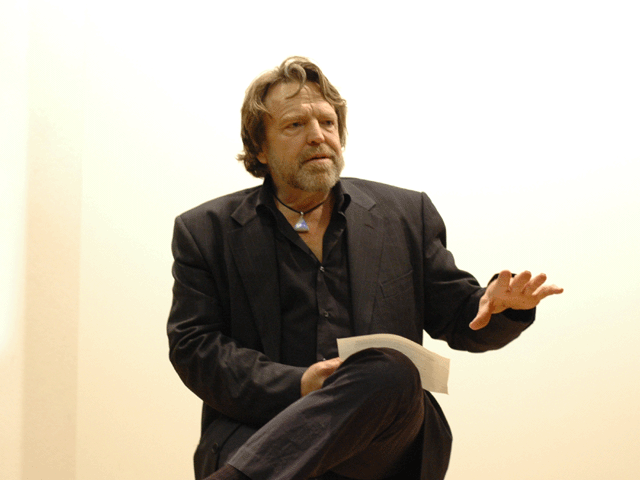
"The Internet is a global system of interconnected computer networks that...serve billions of users worldwide" (Internet). It consists of millions of private, public, academic, business, and government networks that are all linked together. Today, the Internet is limited only by one's imagination. It is "the new home of Mind" (Barlow). That quote, made by John Barlow in 1996, is from his manifesto, A Declaration of the Independence of Cyberspace. It was a pronouncement that the Internet was outside any country's borders and therefore there was no government that could apply laws to it. It is a "world that is both everywhere and nowhere, but it is not where bodies live" (Barlow). This world of communication and "civilization of the Mind" cannot be contained by a set of laws.

John Barlow
"The Internet by 2010 had become a fledgling universal network of all types of data: phone calls, video and television, data, a potential replacement for every single information industry of the twentieth century" (Wu 256). The Internet has evolved beyond that which anyone could have ever imagined. But is it becoming too connected? Tim Wu thinks so. He believes we should apply what he calls a Separations Principle to the many information industries of society. This principle would create a "salutary distance between each of the major functions or layers in the information economy" (Wu 304). It is a system of checks and balances that prevents a monopoly from arising. The Internet would be an exception to this principle, however. It is not controlled by anyone and there are very few substitutes for it. Because the Internet encompasses masses of functions, such a system of checks and balances would be a monumental task to achieve. And what of the Declaration of Independence of Cyberspace? It is impossible for anyone to make laws in a world that is as infinite as the mind allows it to be.

Everything is backed by money and power in the world of information industries. It is about gaining as much money and power and keeping it as long as possible. It is why major companies such as Google and Microsoft buy out smaller competing companies. They want their potentially profitable ideas for their own. For this reason, the Separations Principle will not work. This principle may create a cartel and sooner or later selfish desires prevail, ruining any agreement previously set forth. Even if such a body of checks and balances were to come about it would be short-lived. The information technologies of the twentieth century are becoming more and more obsolete. The Internet combines the functions of the many information industries of television, film, and mobile devices. The companies of the many information industries strive to maximize profits. Conversely, consumers want to spend as little money as possible. Once you own a computer, the only costs for Internet use are to Internet Service Providers (ISPs). Once connected, the whole Cyberspace world is at your fingertips. Consumers are going to want to use the cheaper, more immersive Internet rather than the more expensive, separate technologies. It is only a matter of time before the Internet literally becomes an immersive experience similar to the one described in William Gibson's Neuromancer.

Ultima Online
Even today, we begin to see the stepping stones of a virtual, immersive Cyberspace. There are millions of people who play dozens of massively multiplayer online role-playing games - MMORPGs (Dibbell 11). The virtual game world allows the user to escape to a fantasy world. Even in 1996 Barlow saw what the Internet truly was; "a world that all may enter without privilege or prejudice accorded by race, economic power, military force, or station of birth...where anyone, anywhere may express his or her beliefs, no matter how singular, without fear of being coerced into silence or conformity" (Barlow). As technology advances, it may be possible for us to physically enter these virtual game worlds and physically be there as opposed to clicking a mouse. For those who are not avid MMORPG players, there is a similar program that could lead to immersion. "Video chat" programs such as Skype are ones that connect two or more people via a video feed that creates the illusion of being face-to-face. We prefer this type of technology because we can see who we are talking to. Cisco Telecommunications has products similar to Skype designed for the business world. "To deliver an immersive collaborative environment with an in person experience, the Cisco TelePresence System 3010 allows 6 people to connect with up to 48 locations" (Cisco). In the description it is defined as an immersive experience. It won't be long before MMORPGs and video chat programs lead to a 3-Dimensional Cyberspace that users materially enter.

However, I cannot see humans wanting to have a "cord" stuck into the back of their heads to enter this Cyberspace world like the way Gibson describes. Rather, I can see a system similar to the one created in James Cameron's Avatar. A person could lie in a link system that connects their nervous system with an avatar or created character in the cyberspace world. I am extremely curious as to what happens to someone who would get "lost" or even die in this Cyberspace world. Do they die in reality as well? Or is it similar to Christopher Nolan's Inception where someone falls into "limbo" and is lost forever? It is almost like creating a second, parallel universe. How that universe connects to the real one we have now will be something that will be difficult to grasp and even define.


Even at the dawn of the Internet's use, Gibson realized that we would be completely dependent on the Internet in the future. Much of the population relies on the Internet every day. Either through computers, smart phones, or iPads, our dependence on the Internet has grown. This addiction was just recently brought to the forefront with the uprising in Egypt. The Egyptian government decided to block all Internet traffic in response to protests against the government. This has only created more protests. "Egypt's government must return Internet access to the country...or perhaps suffer massive economic damage, as banks and other economic institutions return to work without the ability to conduct commerce" (Rothman). The global world has become completely reliant on the Internet; almost everything is connected through it. Our economies depend on it to continue to expand, grow, and remain competitive. It is becoming more apparent that our love for the Internet is leaving us incapable of living and functioning without it on almost every level.

In a previous blog post, I said that we must use our technology appropriately without becoming dependent. This is a difficult concept to put forth and maintain. If we do not, we will lose sight of what is real and what is fake. It seems that if we continue down the path that we are currently on, our conception of reality and fantasy will become blurred. I am afraid that our world will become exactly like the one in Inception. We will be unable to tell the difference between the real world we live in and the imagined one we have created in our minds. We will need "totems" to be able to distinguish in what world we are living. The Internet has been a blessing that has opened up a vast number of doors for advancement and connection, but with every new great technology comes dangerous side effects.

totem from Inception
After about a half hour, I was able to connect to the school's network and writing became faster and less tedious. I used the Internet sparingly. However, the knowledge that it was available if necessary made it easier to retrieve needed information and organize my thoughts into writing. The dependence on constant connectedness is one I feel cannot be reversed nor should it be. Rather, it will increase exponentially until Gibson's vision of a "consensual hallucination" is a reality (Gibson 5). Will the Internet continue to be a phenomenon that allows for infinite ideas or will it one day backfire into a worldwide disaster? Only time and mankind will provide the answer.

Works Cited
Barlow, John P. "A Declaration of the Independence of Cyberspace." Web. 13 Feb. 2011. <https://projects.eff.org/~barlow/Declaration-Final.html>.
"Cisco TelePresence System 3010 - Cisco Systems." Cisco Systems, Inc. Web. 13 Feb. 2011. <http://www.cisco.com/en/US/products/ps10753/index.html>.
Dibbell, Julian. Play Money: Or, How I Quit My Day Job and Made Millions Trading Virtual Loot. New York, NY: Basic, 2006. Print.
Gibson, William. Neuromancer. New York: Ace, 1994. Print.
"Internet." Wikipedia, the Free Encyclopedia. Web. 13 Feb. 2011. <http://en.wikipedia.org/wiki/Internet>.
Rothman, Wilson. "Net-less Egypt May Face Economic Doom Monday." Technolog. 28 Jan. 2011. Web. 13 Feb. 2011. <http://technolog.msnbc.msn.com/_news/2011/01/28/5942650-net-less-egypt-may-face-economic-doom-monday?ocid=twitter>.
Wu, Tim. The Master Switch: the Rise and Fall of Information Empires. New York: Alfred A. Knopf, 2010. Print.

Monday, February 21, 2011

Please Turn Off All Electronic Devices

This past weekend I flew to Boston to visit my girlfriend. As many of you who have flown before know you are required to turn off all cell phones during the duration of the flight. About 30 seconds after the wheels of the plane first touched the ground in Richmond I turned my phone back on. I looked to my right and the woman next to me, who was probably in her late 50s or early 60s had turned her Blackberry back on. I looked to my left and a man in his 40s turned on his HTC smartphone and the college-aged girl next to him turned on her Blackberry. I stopped looking at my own phone for a second to soak in what I just saw. Three different individuals, all a different age and sex glued to their smartphones that they needed to check immediately upon landing. Woah.

After finding my smiling roommate who picked me up and returning to campus (after getting slightly lost), I began to think about what I saw when my plane landed. It seemed to me that more and more people are trying to follow the trends of technology. It seems that more and more people are turning to smartphones for their mobile devices. This is not just teens or adults of the business world, but people of every age and sex. I was utterly shocked when I saw the nice, old lady next to me who was reading Eat Pray Love take out a Blackberry when we landed. It seems that the constant connectedness to everyone and everything is so important to so many. Smartphones enable everyone to do so much. I understand that not everyone has a smartphone (such as my parents and grandparents) but there are an increasing number of owners today. There are currently an estimated 500 million smartphone users globally.

A majority of the general public tends to keep up with current trends in the technological markets. It will be interesting to see what the smartphone develops into next. It will be even more interesting to see how prevalent it is in our everyday lives.

Smith, Graham. "Surge in Smartphone Users Blamed for Clogging up Mobile Networks | Mail Online." Mail Online. 15 Feb. 2011. Web. 21 Feb. 2011. <http://www.dailymail.co.uk/sciencetech/article-1357174/Surge-smartphone-users-blamed-clogging-mobile-networks.html>.

Monday, February 14, 2011

Virtual Me

As I read Play Money I can't help but remember my middle school days when I played massively multiplayer online role-playing games (MMORPGs). I read Dibbell describe his early days in the online gaming world and can't help but see myself. When I was younger my game was Runescape. All my friends played it and it was the popular thing with all of the guys. The interesting thing was how much I related to the early experiences Dibbell had when he first starting playing. He told stories of how he simply went around doing the same thing over and over again. From what I remember, that was exactly what I did!

My character would walk around Runescape, or whatever the virtual world was called, and I remember I kept making it mine for specific ores so I could sell them and get as much gold as possible. But then what? I would buy a new sword or armor, but that was it. It was an endless cycle that I loved to go to every day. Now looking back on it and reading a book almost about the exact same thing in college made me laugh. It was almost kind of pathetic that that was what I did every day after school. Yet there are adults that do the exact same thing today. What is that driving force that brings people back day after day to the same thing?

I think that desire is from the ability to simply get away and be someone else, somewhere else. In online, virtual worlds you can be whoever you want to be. That is why they have become so popular and stayed that way for many years. I can definitely see a 3-Dimensional virtual world for gamers in the near future and possibly an immersive one not too far down the road.